Pest & Crop Newsletter



 |
|||||||||||||||||||||||||||||||||
|
|||||||||||||||||||||||||||||||||
 |
|||||||||||||||||||||||||||||||||
A Nibble Here, A Nibble There, Silk Snackers Want Their Share– (John Obermeyer, Larry Bledsoe, and Rich Edwards)
Tasseling is beginning throughout the state. Pollinating corn should be monitored for several species of insects that feed on silks. Especially this year, as many ponded areas of fields are delayed and may become a “trap crop” for these silk feeders. Western and northern corn rootworm beetles are most often observed. Others, such as the Japanese beetle and woollybears can occasionally cause some concern. The following is information on each of these species and if or when they should be controlled: Rootworm beetles - Adult rootworms are emerging throughout the state. If rootworm beetles are present in commercial corn fields during pollination, control may be necessary if the silks are clipped off to within 1\2 inch or less of the tip of the ear before 50% pollination is completed. It has been suggested that 5 beetles per plant can result in the need for control, however, many fields have had higher numbers during pollination with little or no silk clipping activity. So, do not judge the need for treatment based on beetle numbers. On the other hand, research with inbreds in seed production fields has shown that 2 to 3 beetles per plant can significantly reduce ear fill. Although rootworm beetles prefer to feed on corn pollen and silk, they will feed on corn leaves when pollen and silks are not available. When the beetles feed on the leaves, they remove the upper layer of leaf tissue resulting in areas on the leaf that appear gray or silver. It has not been shown that this leaf feeding results in any loss in yield. Japanese beetle - Japanese beetle will feed on silks and infestations occasionally reach levels high enough to interfere with pollination. Base treatment decisions on degree of silk clipping and stage of pollination. Treatment is probably justified if beetles are continually clipping silks to within 1/2 inch or less of the ear tip before 50% pollination has taken place. Japanese beetle infestations are usually spotty in fields, especially in the end-rows. Don’t be overly alarmed at the few ears that may be clumped with these “social” insects. Be certain to inspect the whole field. Japanese beetle are attracted to the smell of dying and/or dead silks. Therefore, determine whether pollination is nearing completion before treatment decisions are made. Woollybears - Yellow or brown “woolly” worms can be observed feeding on corn silks and/or leaves. These furry caterpillars are the larvae of several species of tiger moths. When populations are high, producers have no difficulty in seeing the worms or their damage. When woollybear caterpillars feed on corn silks, they may clip the silks to the tip of the ear. They normally then move to an adjacent plant to continue feeding. The “clipped-silks” will continue to grow at the rate of approximately one inch per day until pollinated or until the end of the pollination process. Infestations are rarely serious enough to require control. However, a spot treatment may occasionally be required if the population and damage is particularly high within a given area of a field. If an insecticide is needed, most of those recommended for rootworm beetle control should provide adequate control. For a good refresher on corn pollination, refer to this week’s Agronomy Tips, “Suggestive Behavior in the Corn Field.” Understanding of this a-maize-ing process helps one better determine if and when silk feeders hinder fertilization.
Corn Lodging Reported– (John Obermeyer, Larry Bledsoe, and Rich Edwards)
Lodging and subsequent “goosenecking” of some first-year corn fields have been reported this week. Damage has varied from lodging in isolated spots (typical) to whole fields laying flat. Recent rains coupled with gusty winds have revealed the rootworm’s root damage. Many producers may have a surprise for them this fall as they attempt to harvest and find areas of flat corn. Many of the fields damaged had a planting-time insecticide applied, therefore don’t rule them out. NOW is the time when first-year and continuous corn fields need to be evaluated for rootworm damage; post-mortem, or harvest, diagnosis is difficult at best. Corn plants that have tilted or lodged should be dug, not pulled, washed and then inspected for root feeding scars. Pay particular attention to the nodes of roots just below and above the soil surface, these may have been completely destroyed. There is nothing that can be done to correct this year’s damage. However, these fields may have a tremendous beetle population as they continue to emerge from the soil and begin silk feeding. Those fields that sustained significant damage and had full rates of rootworm insecticides applied should have a dealer or manufacturer's representative evaluate the situation. Should you observe significant rootworm damage in first-year corn we would be very interested in hearing from you. Please call us: (765) 494-4563.
|
|||||||||||||||||||||||||||||||||
 |
|||||||||||||||||||||||||||||||||
The Impact of Excessive Rainfall on Soybeans– (Ellsworth P. Christmas)
Significant quantities of rain have fallen over the past two months with the heaviest amounts in the last two weeks falling north of a line from Princeton to Muncie, Indiana. Knox and Dubois Counties received amounts in the 4 to 4.5 inch range during this period with heavy rains occurring on June 17. Reporting stations in Tippecanoe, Whitley and Porter counties recorded 5.5 to more than 7 inches during this same period with heavy rainfall on June 24. Much of this rain fell on soils that were already quite wet from and, in some cases, already saturated from previous rainfall. The net result of all of this rain is saturated soils in much of the state with significant ponding and some flooding. Anytime these types of wetness problems occur, the immediate question relates to the length of time that a given crop can survive if covered by water. For soybeans, the length of time that a plant can remain completely submerged and survive is between 2 and 4 days assuming the soils were not saturated when the flooding occurred. The length of time is also related to temperature and cloud cover. Hot, sunny conditions may result in death of the plant after 2 days or less while, with cool, cloudy conditions, soybeans may survive after 4 days or more. If a portion of the plant is exposed, soybeans have been known to survive after 7 days of partial submersion. If flooding occurs in fields where the soils have already been saturated for a few days, the soybean plants are less likely to survive. Soybeans require well-aerated soils to grow vigorously. Saturated soils, with no water on the above ground portion of the plant, can result in poor root and plant growth and some plant death from root rot diseases. After only a few days of saturated soils, soybean plants become a lighter green color due in part to poor nitrogen fixation since little oxygen is present in these saturated soils. In addition to the saturated soils, nighttime temperatures have been too cool for good soybean plant growth. Soybeans perform best with nighttime temperatures in the 70 to 80 degree range. During the last two-week period, we have had a number of cloudy days that have also contributed to the poor growth and light green or yellow color of the soybeans. Finally, post-emergence herbicides are being applied to a soybean crop under considerable stress and in many cases adding yet another stress to the plants and contributing to the light green to yellow color. The bottom line is that growing conditions are far from ideal for the soybean crop. Warm nighttime temperatures, bright sunny days and a few days free of added rainfall will bring this crop around and change its appearance significantly. These changes need to occur shortly since the soybean plant has moved into the reproductive stages of growth and continued stresses can begin to take a toll on yield potential.
Soggy Soils Severely Stunt Stands of Corn– (Bob Nielsen)
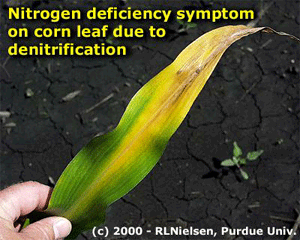
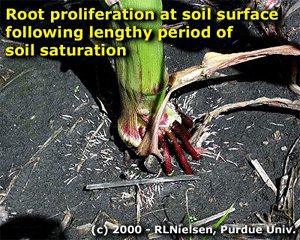
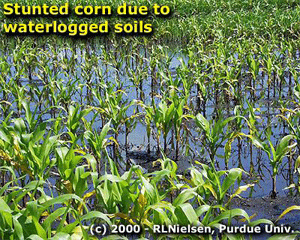
Is the drought over for this year? According to both the National Drought Mitigation Center and the Climate Prediction Center (NOAA), Indiana is drought-free for the first time in this millenium. Certainly the recent rains across the state have helped us forget about drought stress for the time being. In fact, quite a number of corn fields are instead suffering from the effects of soggy soils on root health. In an earlier article (Pest&Crop #14) I shared my thoughts on the effects of flooding and ponding on corn survival. After walking a number of fields since then, it seemed appropriate to share some additional observations on the effects of soggy soils on crop health. The consequences of ponding or saturated soils on corn health can be astounding in late June when temperatures are in the 80’s. In fact, some folks called and asked how can corn be so dramatically stunted in so short a period of time? Well, first of all, some areas have been soggy off and on for weeks now. The saturated soil condition didn’t just happen overnight. The accumulated stress of chronic ‘wet feet’ takes a greater toll on root health than does a single soggy event. Secondly, not only are we seeing the effects of nitrogen loss (denitrification or leaching) on overall corn appearance in the soggy areas, but the plants’ roots are also literally dying from the lack of soil oxygen. These two factors together are very damaging to the health of a corn crop. Consequently, one will often find a blurred mixture of true nitrogen deficiency and plain old leaf death from dying roots among plants in soggy areas. Thirdly, the effects of soggy soils are protracted in poorly drained no-tilled fields with significant levels of surface trash. Surface trash limits soil evaporation and extends the time period within which the soils remain saturated. Corn health can deteriorate amazingly fast under such conditions. Fourthly, some hybrids simply have a lower tolerance to ‘wet feet’ than others. Unfortunately, few, if any, companies rate their hybrids for such tolerance. Even if they did, Murphy’s Law says that hybrids tolerant to soggy soils would probably be susceptible to drought conditions!
Finally, another factor related to the apparent rapid deterioration of corn in soggy areas is that the corn growing outside of those areas continues to grow normally. In fact, given the warm temperatures of late plus the ample supply of soil moisture plus the fact that the crop is smack dab in the middle of its rapid growth phase all contribute to a rapid rate of crop growth and development. So, part of our astonishment at the severity of stunting in the soggy areas is an optical illusion of sorts caused by the fact that the rest of the field is growing by leaps and bounds. Consequently, the appearance of the stunted yellowish corn in the soggy areas is amplified by the rapidly developing taller dark green corn in the drier areas of the field. Management Decisions: The primary management decision to be considered as a result of soggy soils in corn fields is whether those areas will benefit from any additional nitrogen fertilizer applications once the soil dries enough to support ground equipment. Loss of available soil nitrate is in the neighborhood of five percent per day of waterlogged soils and consequently will constitute significant N loss in areas of some fields this year. The complicating factor for many Indiana corn fields from here on is that they are already beyond the maximum safe height for traditional sidedressing equipment. Even if the stunted areas are technically short enough for ground equipment, the height of the healthier areas of the fields will prevent traditional ground equipment from getting to the stunted areas without causing significant damage on the way. The following advice on how to apply late N fertilizer comes from John Sawyer at Iowa State University <http://www.ent.iastate.edu/ipm/icm/2000/7-3-2000/whataboutn.html>:
“When conventional application equipment can be moved through the field (the soils are dry enough and the corn is short enough), then injection of anhydrous ammonia or UAN solutions would top the list of best options. Next would come dribble UAN between corn rows, then broadcast urea. Broadcast UAN solution should be avoided because it can burn corn foliage, especially with large corn. If injection or conventional broadcast application is not possible …, then UAN could be applied with high-clearance equipment with drop nozzles that direct the solution onto the ground, or urea could be aerially applied.” The other complicating factor is the extent of ‘permanent’ stunting of the crop caused by the soggy soils themselves. A 50 percent loss in soil N is not very important if 50 percent of the crop’s yield potential is already lost simply due to the soggy soils. From a number of fields that I have seen recently, the stunting is so severe that I doubt that additional N will pay for itself. Finally, be prepared for variable grain moistures at harvest. Remember that the stunted corn in the soggy areas is not simply short but is also stunted in its development. If the plants survive, pollination will occur later than in the rest of the field. Consequently, any grain that is produced in these later pollinating areas of the field will also mature later and will be wetter at harvest than that from undamaged areas of the field. Bottom Line: Many Indiana corn growers will tell you that they don’t mind the drowned out areas of their fields because that usually means there has been sufficient rainfall for the rest of their fields to yield very well.
Suggestive Behavior in the Corn Field– (Bob Nielsen)
From my windshield surveys of corn fields in recent days throughout the southern two-thirds of the state, it is obvious that many fields are in or moving into the critical flowering stage of pollen shed and silking. Success or failure during this period of the corn plant’s life will greatly determine the yield potential at harvest time. As important as this process is to determination of grain yield, it is surprising how little some folks know about the whole thing. Rather than leaving you to learn about such things “in the streets”, here are the fundamentals about sex in the corn field. Remember that corn has both male flowers and female flowers on the same plant (a flowering habit called monoecious for you trivia fans.) Interestingly, both flowers are initially bisexual (aka ‘perfect’), but during the course of development the female components (gynoecia) of the male flowers and the male components (stamens) of the female flowers abort.
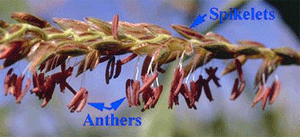
Tassels & Pollen The anthers are those gizmos that hang from the tassel during pollination. Under a magnifying lens, anthers look somewhat like the double-barrel of a shotgun. Don’t mistake anthers for the pollen itself. Pollen is contained inside the anthers. The yellow ‘dust-like’ pollen that falls from the anthers of the tassel actually represent two to five million individual, nearly microscopic, spherical, yellowish-translucent pollen grains. Each pollen grain contains the male genetic material necessary for fertilizing the ovary of one potential kernel. All of the pollen from a single anther may be released in as little as three minutes. An individual tassel may take as long as seven days to finish shedding its pollen, although the greatest volume of pollen may be shed during the second and third day of anther emergence. Because of natural field variability in plant development, a whole field may take as long as 14 days to complete pollen shed. If the anthers are wet, the pores will not open and pollen will not be released. Thus, on an average Indiana summer morning following a heavy evening dew, pollen shed will not begin until the dew dries and the anther pores open. Cool, cloudy, humid conditions also delay the onset of pollen shed. Similarly, pollen is not shed during rainy conditions. So, growers need not worry about pollen being washed off the tassel during heavy rainfall. Extreme heat stress (100°F or greater) can kill corn pollen, but fortunately the plant avoids significant pollen loss by virtue of two developmental characteristics. First of all, corn pollen does not mature or shed all at once. Pollen maturity and shed occur over several days and up to two weeks. Therefore, a day or two of extreme heat usually does not affect the entire pollen supply. More importantly, the majority of daily pollen shed occurs in the morning hours when air temperature is much more moderate.
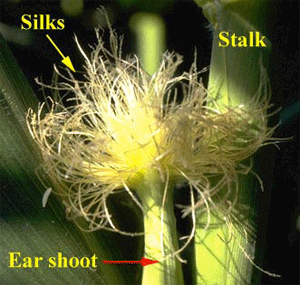
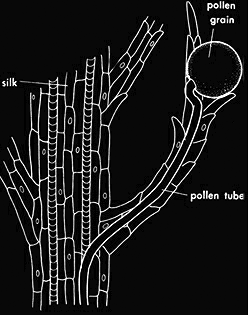
Ears & Silks Silk elongation begins 7 to 10 days prior to silk emergence from the husk. Complete silk emergence from an ear generally occurs within two to seven days. Silks from the basal portion of the ear typically emerge first, while the tip silks generally emerge last. Pollination & Fertilization Pollen grain germination occurs within minutes after a pollen grain lands on a receptive (moist) silk. A pollen tube, containing the male genetic material, develops and grows inside the silk, and fertilizes the ovary within 24 hours. Pollen grains can land and germinate anywhere along the length of an exposed silk. Many pollen grains can germinate on a receptive silk, but typically only one will successfully fertilize the ovary. Silk clipping by certain insects like the corn rootworm beetle not only removes viable silk tissue, but also injures a certain length of the remaining silk. Generally, silk length on these injured ear shoots must be at least 1/2 inch to ensure that a sufficient length of uninjured silk tissue is exposed for pollen germination to occur. Silk receptivity to pollen grain germination exists up to 10 days after silk emergence. After 10 days, silk receptivity decreases rapidly. Silk elongation continues until pollination is successful, although elongation eventually ceases as unfertilized silks senesce. Issues for 2000 The consequences of delayed or variable flowering dates are 1) the increased risk of poor or uneven kernel set due to insect or weather stress during the later flowering period and 2) greater variability in grain maturation within a field and the subsequent grain moisture at harvest. The greater risk of insect or weather stress during later flowering is due to the attraction of certain insects (e.g., CRW beetles) to late flowering corn and to the somewhat greater risk of warmer temperatures and drier conditions in late July/early August compared to current conditions. *Footnote: Versions of this article published in years past included the word “sex” in the title. After several E-mail messages from elementary school teachers chastising me for this rather flippant use of the word in its referral to the corn pollination process, I humbly (albeit still flippantly) substituted the words “suggestive behavior” for the word “sex” in the title. Don’t forget, this and other timely information about corn can be viewed at the Chat ‘n Chew Café on the World Wide Web at <http://www.kingcorn.org/chatchew.htm>. For other information about corn, take a look at the Corn Growers’ Guidebook on the World Wide Web at <http://www.kingcorn.org/>.
|
|||||||||||||||||||||||||||||||||
 |
|||||||||||||||||||||||||||||||||
Monitoring Soybeans For Rootworm Beetles With Yellow Sticky Tape - (John Obermeyer, Larry Bledsoe, and Rich Edwards)
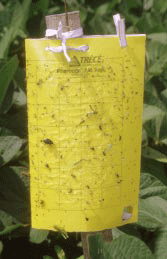
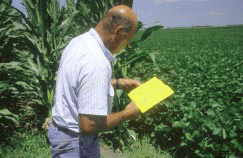
Economic larval damage has been observed again this year in some first-year corn fields following soybean. Obviously it is too late to do anything about the root damage this year, efforts should now be to determine where the beetles are laying their eggs and how many for next year. Rather than assuming that this problem exists in all fields, and thus blindly applying insecticide to all of next year’s first-year corn, pest managers throughout the state have the opportunity to be proactive and to utilize scouting as a way of assessing beetle populations. Pherocon AM yellow sticky traps placed on stakes throughout the soybean is a passive method of sampling the western corn rootworm beetle population. There are no lures (pheromone or food) on these cards, the beetles are attracted to the bright yellow color and then become entangled in the sticky surface. The purpose is to improve risk assessment for damage by rootworm larvae to corn following soybeans. Traps are placed in different locations of the soybean field on a weekly basis; for ease of collecting traps in drilled soybean, consider placing them along wheel tracks, skipped rows, etc. The traps are positioned on the stake or post so that the traps are hung just above the soybean canopy. Each week, for six weeks, the traps are removed and new ones are positioned just above the growing plants. Beetle counts are then taken and recorded from the removed cards in the field or preferably a cooler location.
The following is a suggested sampling protocol: 1. Select a 2000 soybean field that will be planted to corn in 2001. Keep the test area size manageable, 40 acres is better than 120. 2. Attach a Pherocon-AM (non baited) yellow sticky trap (fold so that sticky side is out) around a stake that is tall enough to reach the top of the soybean canopy. Use heavy-duty twist ties that are included with the sticky traps to adjust the height of the traps on the stakes. The traps can also be stapled to the stake. The bottom of the traps should be level with the top of the soybean canopy. Wood lath, furring strips, fence rods etc. can be used as stakes. Warning, should a stake and/or trap be knocked over (wind, deer, etc.), they are very difficult to relocate…metal posts and combines don’t mix! 3. Beginning on the week of July 24, place six sticky traps (on stakes) in separated areas of the test area. Keep at least 100 feet away from the field edge or waterways. Place the traps in any random pattern, but consider efficiency as they need to be visited weekly. A small path may have to be formed through drilled beans to reach the trap sites. Experience has shown us that these paths damage the beans very little. Completely remove traps during the week of August 28 and end experiment. A maximum of thirty six traps will be needed for each field in the experiment. 4. Visit the traps weekly from July 24 through August 28 (six weeks). Each week remove the trap and fold it carefully so the sticky sides are no longer exposed. Place the folded trap in a plastic bag so that you can count the beetles later in a place where it is more comfortable. Put a new trap on the stake. If you can’t immediately count the beetles, freeze the used traps, bugs and all, and count when you can. Be sure to mark the field number and sample date (or sequence number) on the trap on the back with an indelible felt-tipped pin. The traps can be frozen for several months. Don’t crush them while they are frozen. Thaw for about 30 minutes before opening and counting. Most beetles will be intact, but they may be a little darker than when they were alive. 5. Record data as number of beetles/trap/day/field. Do not average or combine data. You should have 6 dates (weeks) X 6 traps = 36 data records for each field. Pherocon AM yellow sticky traps can be purchased from several distributors. A couple of companies, with telephone numbers, are (this listing is not all inclusive, nor an endorsement): Gempler’s (800) 382-8473 and Great Lakes IPM (800) 235-0285. Thresholds to determine the risk to next year’s corn from western corn rootworm beetles captured in this year’s soybeans are forthcoming. Both Purdue and the University of Illinois will soon be releasing economic thresholds. Stay tuned to future issues of the Pest&Crop.
|
|||||||||||||||||||||||||||||||||
 |
|||||||||||||||||||||||||||||||||